News & Events Details
May
REG and Rwanda Polytechnic Strengthen Industry-Academia Collaboration Through Innovation Challenge
Rwanda Energy Group has reaffirmed its commitment to innovation and collaboration with academic institutions after joining Rwanda Polytechnic in the closing ceremony of the annual “RP Skills Challenge 2026 Edition: Hackathon” held on Friday, May 8, 2026.
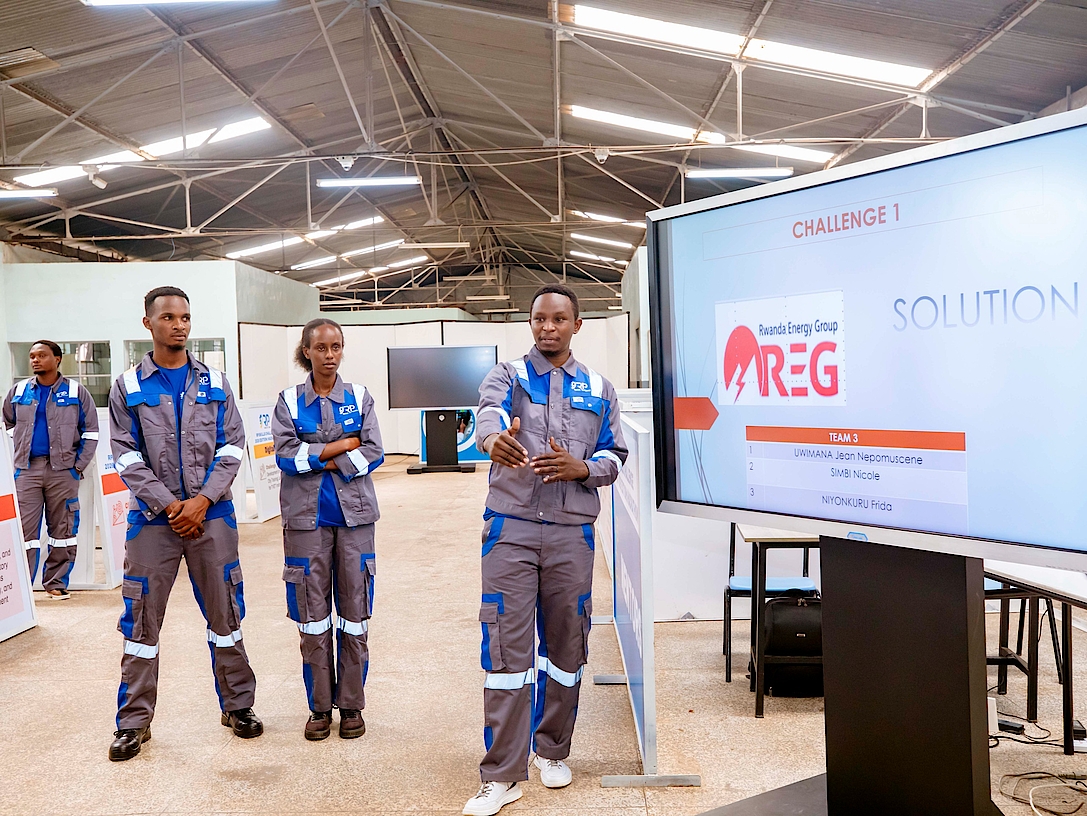
The competition brought together students, industries, and institutions to develop technological innovations aimed at solving real-life operational challenges faced by companies and organizations in Rwanda. Through the Hackathon, students were given an opportunity to apply practical skills, think critically, and collaborate in designing innovative solutions tailored to industry needs.
Among the standout projects during the competition was an Artificial Intelligence (AI)-powered solution developed to help Rwanda Energy Group combat theft and vandalism of electricity infrastructure. The project was developed by RP Musanze students Eric Ndikumana and Ishimwe Steven.
The innovative solution uses cameras and sensors integrated with Artificial Intelligence technology capable of detecting suspicious movements around power installations such as substations. Once a person is detected, the system analyzes the activity in real time and immediately alerts relevant REG teams for quick intervention.
Speaking about the innovation, Eric Ndikumana From RP Musanze explained that the uniqueness of the project lies in the ability of the AI-powered cameras not only to detect individuals but also to analyze their actions.
“The innovation in our project is that even if a thief attempts to enter REG facilities such as substations, we installed cameras and sensors capable of detecting anyone approaching. The camera captures the person and sends the information to Artificial Intelligence (AI), which analyzes the situation and immediately alerts all relevant REG departments so they can quickly respond and apprehend the thief. What is unique is that the cameras can analyze what the person is doing, not just detect their presence,” he said.
His teammate, Ishimwe Steven, expressed hope that the project will move beyond the prototype stage and eventually be implemented to produce tangible results.
“Our wish is for our project to be implemented so it can start producing results,” he noted.
Rwanda Energy Group highlighted that the company already maintains strong collaboration with Rwanda Polytechnic in various initiatives and that this new innovation further strengthens the partnership between industry and academia.
Jean Paul Iradukunda, Head of the Department of Innovation and Technology Development at REG, praised the students for their creativity and technical capabilities, saying the project demonstrates the quality of practical education being delivered at Rwanda Polytechnic.
“The students are capable, and RP provides quality education. You can clearly see progress. Regarding the project they developed, they did a good job, although it still needs further refinement and additional features. What they created clearly has the potential to help REG. We will work closely with them to see what can be improved and begin with a pilot project. If we find that it delivers results, we will present it to senior management, and if it proves successful, we can develop it into a fully operational project for REG infrastructure,” he said.
The Hackathon attracted participation from 48 students grouped into 18 teams who worked on six industry challenges submitted by different companies and institutions. The projects covered sectors including technology, mining, telecommunications, manufacturing, and sustainable energy.
Within the Digital and Social Transformation Cluster, participating companies included Airtel Rwanda, which received an Inventory Management System for End User Equipment; De Lorenzo Global, for which students designed a Smart City Virtual Laboratory for TVET institutions; and Rwanda Energy Group, whose challenge inspired the AI-powered anti-vandalism solution.
Other innovation clusters included the Transformative Manufacturing Cluster, where students developed a multi-purpose hydraulic press for REMCO and designed a tin recovery system for GAMICO. In the Sustainable Energy Cluster, students designed a solar energy plant solution for Inyange Industries to support pumping and lighting systems.
The closing ceremony was attended by the State Minister in the Ministry of Education, Claudette Irere, who commended the students for their innovation and urged stronger collaboration between technical institutions and industries to ensure that such projects are implemented and scaled up.
“What we are asking for is collaboration between technical schools like these and the private sector, because without such cooperation, these innovations remain here unused. We also encourage teachers to stay updated with current trends and integrate them into what students learn,” she said.
The Director General of Rwanda Polytechnic, Dr. Sylvie Mucyo, also emphasized the institution’s commitment to strengthening partnerships with industries to ensure students’ innovations transition from prototypes into practical solutions.
“What we want is to continue improving these prototype projects during what we call the post-challenge phase, while building collaboration so that industries and private companies can use the solutions developed by students. We want everyone to invest effort into this so that students can immediately start working with industries,” she stated.
The RP Skills Challenge 2026 Hackathon once again demonstrated the growing importance of collaboration between academia and industry in driving innovation, practical learning, and technology-based solutions that contribute to Rwanda’s socio-economic transformation.
Categories
Archives
- August 2026
- July 2026
- June 2026
- May 2026
- April 2026
- March 2026
- February 2026
- January 2026
- December 2025
- November 2025
- October 2025
- September 2025
- August 2025
- July 2025
- June 2025
- May 2025
- April 2025
- March 2025
- January 2025
- December 2024
- November 2024
- October 2024
- September 2024
- July 2024
- May 2024
- April 2024
- March 2024
- August 2023
- July 2023
- June 2023
- May 2023
- April 2023
- February 2023
- December 2022
- August 2022
- July 2022
- June 2022
- May 2022
- April 2022
- March 2022
- February 2022
- January 2022
- December 2021
- November 2021
- September 2021
- August 2021
- July 2021
- June 2021
- May 2021
- April 2021
- February 2021
- January 2021
- December 2020
- November 2020
- October 2020
- September 2020
- August 2020
- July 2020
- June 2020
- April 2020
- March 2020
- February 2020
- January 2020
- December 2019
- November 2019
- October 2019
- September 2019
- August 2019
- July 2019
- June 2019
- May 2019
- April 2019
- March 2019
- February 2019
- January 2019
- December 2018
- November 2018
- October 2018
- September 2018
- July 2018
- June 2018
- April 2018
- March 2018
- February 2018
- January 2018
- December 2017
- November 2017
- August 2017
- July 2017
- June 2017
- March 2017
- February 2017
- January 2017
- December 2016
- November 2016
- August 2016
- July 2016
- June 2016
- April 2016
- February 2016
- May 2015
- April 2015
- March 2015
- January 2015
- December 2014
- August 2014
- July 2014
Related News


Our Partners

















Please fill in the form or Call us on our Toll free number 2727