

Overview
Currently, Rwanda imports all its petroleum products requirements from abroad since there is no local production.
The main policy objective for the sub-sector is to ensure safe, sufficient, reliable, sustainable and affordable supply of petroleum product. This entails boosting investments in supply and storage infrastructure.
1. Current fuel storage capacity
As per ESSP (2018-2024), storage capacity target for 2024 is 198 million litres. Currently, installed capacity is at 118 million litres as per table below:
Product | Gatsata (GoR) | Kabuye (Private) | Rwabuye (GoR) | Bigogwe (GoR) | Jabana (Private) | Rusororo (GoR) | Kanombe (GoR) | Total |
Petrol | 7,200,000 | 3,100,000 | 1,900,000 | 3,000,000 | 10,000,000 | 20,000,000 |
| 45,200,000 |
Diesel | 6,700,000 | 2,700,000 | 1,900,000 | 2,000,000 | 10,000,000 | 36,000,000 |
| 59,300,000 |
Kerosene | 1,500,000 | - | - | - |
|
|
| 1,500,000 |
Jet A1 | 0 | - | - | - |
| 10,000,000 | 2,000,000 | 12,000,000 |
Total | 15,400,000 | 5,800,000 | 3,800,000 | 5,000,000 | 20,000,000 | 66,000,000 | 2,000,000 | 118,000,000 |
Petroleum products storage Installed Capacity [liters]
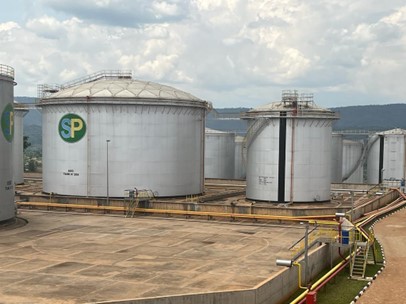
Photo: Rusororo fuel storage developed under PPP between GoR and SP
Investment opportunity is still open for the development of an adequate modern storage facilities equipped to international standards that respond to the national consumption needs as well as to the re-export requirements.
Rehabilitation of existing Government fuel storage facilities
As part of infrastructure development for the petroleum storage, rehabilitation of Rwabuye fuel storage facility in Huye District is currently at 80% and completion is expected in June 2023.
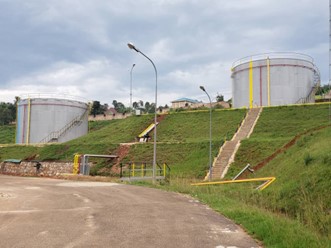
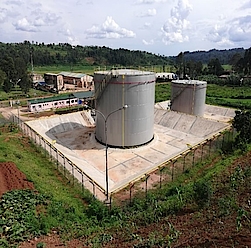
Photo: Rwabuye fuel storage facility
3. Liquefied Petroleum Gas (LPG) storage facility
The National Strategy for Transformation (NST 1) 2017 – 2024 targets to reduce biomass usage for cooking to other cleaning solutions from 79.9% to 42% by. Using LPG to meet cooking energy requirements of household and Institutions is the fastest way for reducing biomass usage. However, different actions including construction of strategic stock facility to ensure supply security.
In this regard, development of new 17,100 m3 of storage facility in Rusororo is ongoing and expected to be completed by April 2024.
Related Projects
110kV Rulindo-Gabiro-Musha
This 110 KV line with its associated substations (Rulindo and Gabiro) connects Rulindo, Gabiro and Musha (Rwamagana) on a distance of 119km.
View projectImproving Access to reliable on Grid Electricity Services for Households and Priority public institutions - BE2EARP
Improving Access to reliable on Grid Electricity Services for Households and Priority public institutions - BE2EARP information published by Rwanda Energy Group.
View project110 kV Gishoma-Bugarama
This is a 13 km long 110 KV transmission line linking Gishoma Power plant to Bugarama Substation.
View projectImproving Access to reliable on Grid Electricity Services for Households and Priority public institutions - BE1EARP
Improving Access to reliable on Grid Electricity Services for Households and Priority public institutions - BE1EARP information published by Rwanda Energy Group.
View project220 kV Mirama-Shango
This is a 220 KV line connecting Rwanda to Uganda with a length of 93.5. It will facilitate the interconnection between the two countries.
View projectScaling- up energy access Project
(a) 25,438 households connected to national electricity, (b)179 schools, 29 health centers and 25 sector and cells administration offices with access to electricity in the project area, by (i) constructing 464Km of MV distribution lines and (ii) 710 Km of LV network.
View project