
Overview
Currently, Rwanda imports all its petroleum products requirements from abroad since there is no local production.
The main policy objective for the sub-sector is to ensure safe, sufficient, reliable, sustainable and affordable supply of petroleum product. This entails boosting investments in supply and storage infrastructure.
1. Current fuel storage capacity
As per ESSP (2018-2024), storage capacity target for 2024 is 198 million litres. Currently, installed capacity is at 118 million litres as per table below:
Product | Gatsata (GoR) | Kabuye (Private) | Rwabuye (GoR) | Bigogwe (GoR) | Jabana (Private) | Rusororo (GoR) | Kanombe (GoR) | Total |
Petrol | 7,200,000 | 3,100,000 | 1,900,000 | 3,000,000 | 10,000,000 | 20,000,000 |
| 45,200,000 |
Diesel | 6,700,000 | 2,700,000 | 1,900,000 | 2,000,000 | 10,000,000 | 36,000,000 |
| 59,300,000 |
Kerosene | 1,500,000 | - | - | - |
|
|
| 1,500,000 |
Jet A1 | 0 | - | - | - |
| 10,000,000 | 2,000,000 | 12,000,000 |
Total | 15,400,000 | 5,800,000 | 3,800,000 | 5,000,000 | 20,000,000 | 66,000,000 | 2,000,000 | 118,000,000 |
Petroleum products storage Installed Capacity [liters]
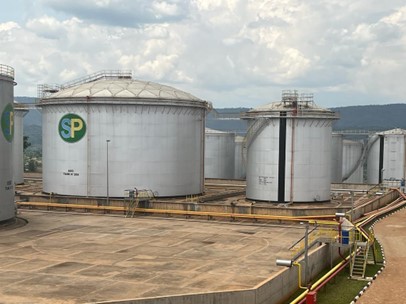
Photo: Rusororo fuel storage developed under PPP between GoR and SP
Investment opportunity is still open for the development of an adequate modern storage facilities equipped to international standards that respond to the national consumption needs as well as to the re-export requirements.
Rehabilitation of existing Government fuel storage facilities
As part of infrastructure development for the petroleum storage, rehabilitation of Rwabuye fuel storage facility in Huye District is currently at 80% and completion is expected in June 2023.
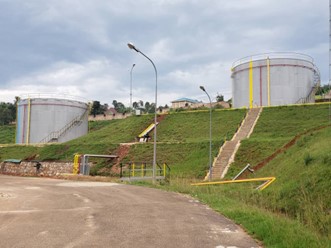
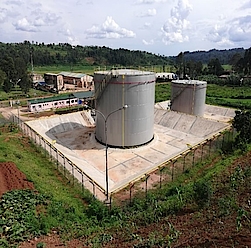
Photo: Rwabuye fuel storage facility
3. Liquefied Petroleum Gas (LPG) storage facility
The National Strategy for Transformation (NST 1) 2017 – 2024 targets to reduce biomass usage for cooking to other cleaning solutions from 79.9% to 42% by. Using LPG to meet cooking energy requirements of household and Institutions is the fastest way for reducing biomass usage. However, different actions including construction of strategic stock facility to ensure supply security.
In this regard, development of new 17,100 m3 of storage facility in Rusororo is ongoing and expected to be completed by April 2024.
Related Projects
110 kV Ntendezi–Bugarama
This project included the construction of a 17.5 km transmission line linking Ntendezi and Bugarama with the associated substations. This line transmission line will ensure power stability in the West of Rwanda and CIMERWA factory
View projectEASSDP- Electricity Access Scale up and sector wide Approach development project. CR N° 4651-RW
EASSDP- Electricity Access Scale up and sector wide Approach development project. CR N° 4651-RW information published by Rwanda Energy Group.
View projectRusumo Falls Hydro Power Project
The project is being developed under NELSAP umbrella for Rwanda, Burundi and Tanzania funded by the World Bank. Rusumo falls Hydropower Project is planned to generate 80 MW and the power output will be shared equally by three countries. The project consists of concrete dam with crest length of 150m,Headrace Tunnel of 460m and a surface power station with…
View projectElectricity Access ScaIe-Up Project Loan Agreement N°1293P”
Electricity Access ScaIe-Up Project Loan Agreement N°1293P” information published by Rwanda Energy Group.
View project110kV Jabana-Mt. Kigali-Gahanga and associated substations
The project consists of building a 27km long 110KV transmission line linking Jabana, Mont Kigali up to Gahanga Substation.
View projectRuzizi III
Rusizi III Hydropower (145MW) construction project is supported by the World Bank, EU, AfDB among others with an expected investment capital of $450 million and is expected to be completed by 2024. The project is being developed under CEPGL umbrella for Rwanda, Burundi and DRC. Rusizi III hydropower project planned to generate 147MW and the power output w…
View project