Overview
Rwanda may have geothermal potential which is manifested in the form of hot springs (Fig. 1) and hosts two prospective zones for geothermal energy exploration: the first zone in the north-western region (Gisenyi, Karisimbi, and Kinigi) which is associated with volcanoes and the second zone in the southern region (Bugarama) associated with faults in the East African Rift (Fig. 2). Three main prospect areas have been demarcated for further exploration: Kinigi, Gisenyi and Bugarama. The potential of geothermal energy is still uncertain.
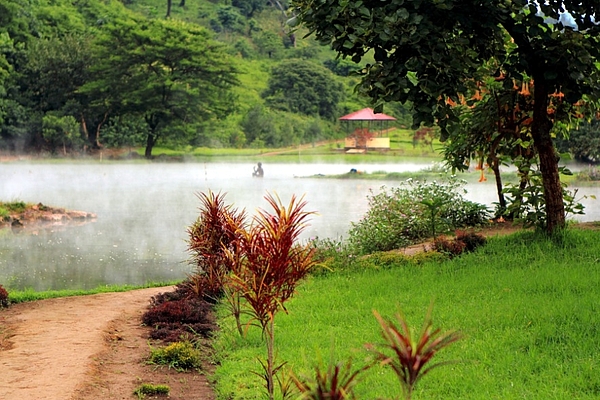
Fig 1: Bugarama hot springs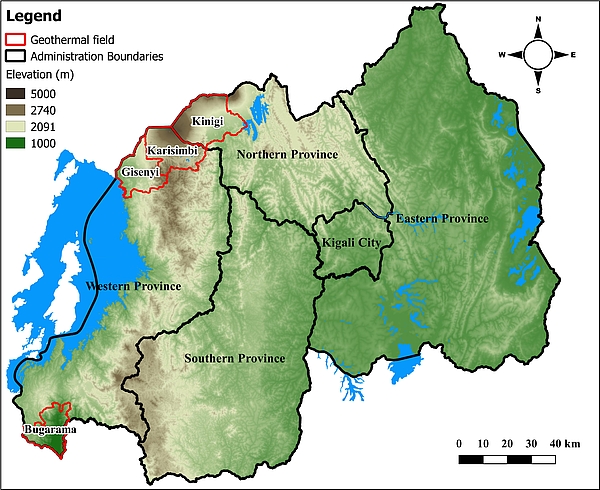
Fig 2: Geothermal potential areas
Overview of Geothermal Development
Serious investigations on Rwanda geothermal resources started in 2006 with a view of diversifying energy sources for electricity generation. Surface geo-scientific studies conducted from 2006 to 2012 indicated that Rwanda has four potential geothermal prospects namely; Karisimbi, Kinigi, Gisenyi and Bugarama. After detailed surface investigations in Karisimbi, two deep exploration wells were drilled with the aim of confirming the existence of the resource. Unfortunately, subsurface geological formation and well testing indicated no evidence of a geothermal system in the Karisimbi drilling area.
Following Karisimbi unfortunate results, a geothermal master plan was developed in 2015. The geothermal master plan provides potential estimates for each geothermal prospect area and gives a clear plan of priorities for the exploration of potential geothermal sites in the country. The potential was estimated at a maximum 100 MW for the country.
Additional surface studies have been conducted in Kinigi prospect and the results from these studies ranked Kinigi as a risky area for geothermal resources exploration.
The new strategy for geothermal exploration suggests for each prospect 5 years of geothermal resources exploration including surface investigations, exploration drilling and well testing followed by 3 years for the construction power plant only if the resource is proven.
The current plan for geothermal exploration is to conduct additional studies in Bugarama and Gisenyi prospects.
Current ongoing activities
Detailed surface investigations have been carried out in Kinigi, Gisenyi and Bugarama prospects and the expected outcome is an update of the conceptual model of the geothermal system in each potential prospect to decide for subsurface exploration.
| Geothermal prospect | Reconnaissance Study | Additional detailed Survey | Gradient Wells | Exploration Wells |
| Gisenyi | Done | Ongoing | FS | FS |
| Bugarama | Done | Ongoing | Done | FS |
(FS: For Schedule)
Given the complexity involved in determining the commercial viability of geothermal power, the Government of Rwanda is committed to reducing risks associated with geothermal exploration by drilling exploration wells to prove the existence of the resource.
Furthermore, Rwanda will host the Seventh Africa Rift Geothermal Conference (ARGeo-C7) in October 2018. The theme of ARGeo-C7 is “Geothermal: Solution to Africa’s Energy needs”. This conference is expected to attract over 400 local, regional and international experts, policy makers, developers and financiers from all over the world.
Project List
Related Projects
110kV Rulindo-Gabiro-Musha
This 110 KV line with its associated substations (Rulindo and Gabiro) connects Rulindo, Gabiro and Musha (Rwamagana) on a distance of 119km.
View projectImproving Access to reliable on Grid Electricity Services for Households and Priority public institutions - BE2EARP
Improving Access to reliable on Grid Electricity Services for Households and Priority public institutions - BE2EARP information published by Rwanda Energy Group.
View project110 kV Gishoma-Bugarama
This is a 13 km long 110 KV transmission line linking Gishoma Power plant to Bugarama Substation.
View projectImproving Access to reliable on Grid Electricity Services for Households and Priority public institutions - BE1EARP
Improving Access to reliable on Grid Electricity Services for Households and Priority public institutions - BE1EARP information published by Rwanda Energy Group.
View project220 kV Mirama-Shango
This is a 220 KV line connecting Rwanda to Uganda with a length of 93.5. It will facilitate the interconnection between the two countries.
View projectScaling- up energy access Project
(a) 25,438 households connected to national electricity, (b)179 schools, 29 health centers and 25 sector and cells administration offices with access to electricity in the project area, by (i) constructing 464Km of MV distribution lines and (ii) 710 Km of LV network.
View project