
Overview
Currently, Rwanda imports all its petroleum products requirements from abroad since there is no local production.
The main policy objective for the sub-sector is to ensure safe, sufficient, reliable, sustainable and affordable supply of petroleum product. This entails boosting investments in supply and storage infrastructure.
1. Current fuel storage capacity
As per ESSP (2018-2024), storage capacity target for 2024 is 198 million litres. Currently, installed capacity is at 118 million litres as per table below:
Product | Gatsata (GoR) | Kabuye (Private) | Rwabuye (GoR) | Bigogwe (GoR) | Jabana (Private) | Rusororo (GoR) | Kanombe (GoR) | Total |
Petrol | 7,200,000 | 3,100,000 | 1,900,000 | 3,000,000 | 10,000,000 | 20,000,000 |
| 45,200,000 |
Diesel | 6,700,000 | 2,700,000 | 1,900,000 | 2,000,000 | 10,000,000 | 36,000,000 |
| 59,300,000 |
Kerosene | 1,500,000 | - | - | - |
|
|
| 1,500,000 |
Jet A1 | 0 | - | - | - |
| 10,000,000 | 2,000,000 | 12,000,000 |
Total | 15,400,000 | 5,800,000 | 3,800,000 | 5,000,000 | 20,000,000 | 66,000,000 | 2,000,000 | 118,000,000 |
Petroleum products storage Installed Capacity [liters]
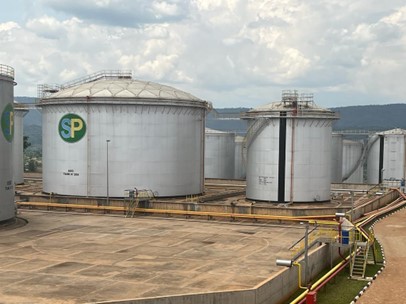
Photo: Rusororo fuel storage developed under PPP between GoR and SP
Investment opportunity is still open for the development of an adequate modern storage facilities equipped to international standards that respond to the national consumption needs as well as to the re-export requirements.
Rehabilitation of existing Government fuel storage facilities
As part of infrastructure development for the petroleum storage, rehabilitation of Rwabuye fuel storage facility in Huye District is currently at 80% and completion is expected in June 2023.
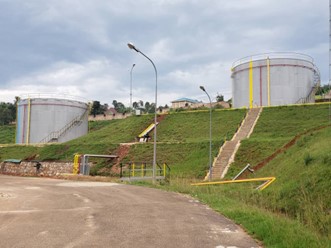
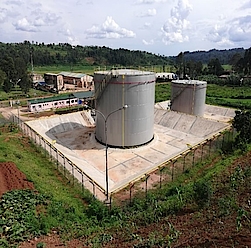
Photo: Rwabuye fuel storage facility
3. Liquefied Petroleum Gas (LPG) storage facility
The National Strategy for Transformation (NST 1) 2017 – 2024 targets to reduce biomass usage for cooking to other cleaning solutions from 79.9% to 42% by. Using LPG to meet cooking energy requirements of household and Institutions is the fastest way for reducing biomass usage. However, different actions including construction of strategic stock facility to ensure supply security.
In this regard, development of new 17,100 m3 of storage facility in Rusororo is ongoing and expected to be completed by April 2024.
Related Projects
220 KV Bwishyura-Kigoma-Rwabusoro
The project consists of building a 62 km long 220KV transmission line linking Bwishyura, Kigoma and Rwabusoro.
View projectKivuWatt Project Phase I
A subsidiary of Contour Global (US-based Company) entered into commercial operations since 31st December 2015 and operates at base load with a nominal gross capacity of 26 MW.
View projectKigali Network Strenghening 1 - 3
Kigali distribution network reinforced (upgrade, rehabilitation and integration to SCADA of 11 identified substations )
View project110 kV Rukarara-Kilinda
This is 110 KV transmission line with a length of 31.5km. It evacuates power from Rukarara Hydropower plant to Kilinda Substation
View projectHakan Quantum Power Project
YUMN Ltd. is developing an 80 MW peat fired power plant in South Akanyaru prospect in Gisagara District and the project is to be developed as Public Private Partnership (PPP). On Feb 10, 2016, Amendment and Restatement Deeds for Power Purchase Agreement, Concession Agreement and Government Guarantee have been signed. Since February 2017 the project is und…
View projectKigali Ring II
Installation of reactive power compensators (capacitor banks) at MV side of the following substations,: Gikondo, Jabana and Birembo. Each substation with 4.5MVAr;
View project